
AI & Engineering Executive | High Trust AI & Agentic AI
Over 24 years driving high-scale AI, cloud, and digital shifts at Amazon and Cisco. Trusted AI is not a model problem alone. It is a systems problem — solved through observability, governance, and runtime controls that keep AI accountable once it's in production. Actively seeking CXO roles and Independent Director positions.
Focused on enabling global enterprises and high-growth startups to launch AI that is provably safe, auditable, and production-ready.

Runtime AI validation
AI observability and telemetry
Responsible AI and governance
Enterprise and regulated environments
The gap between laboratory success and operational reliability is exactly where most AI initiatives fail.
Systems often look perfect in dev but break in production, where data drift and edge cases are far more complex than training sets.
Building trust requires continuous runtime validation rather than static audits — yesterday's metrics won't secure tomorrow's outputs.
Resilient AI needs guardrails, visibility, and robust logic built into the foundation, not added as a patch after a critical error.
The operating loop
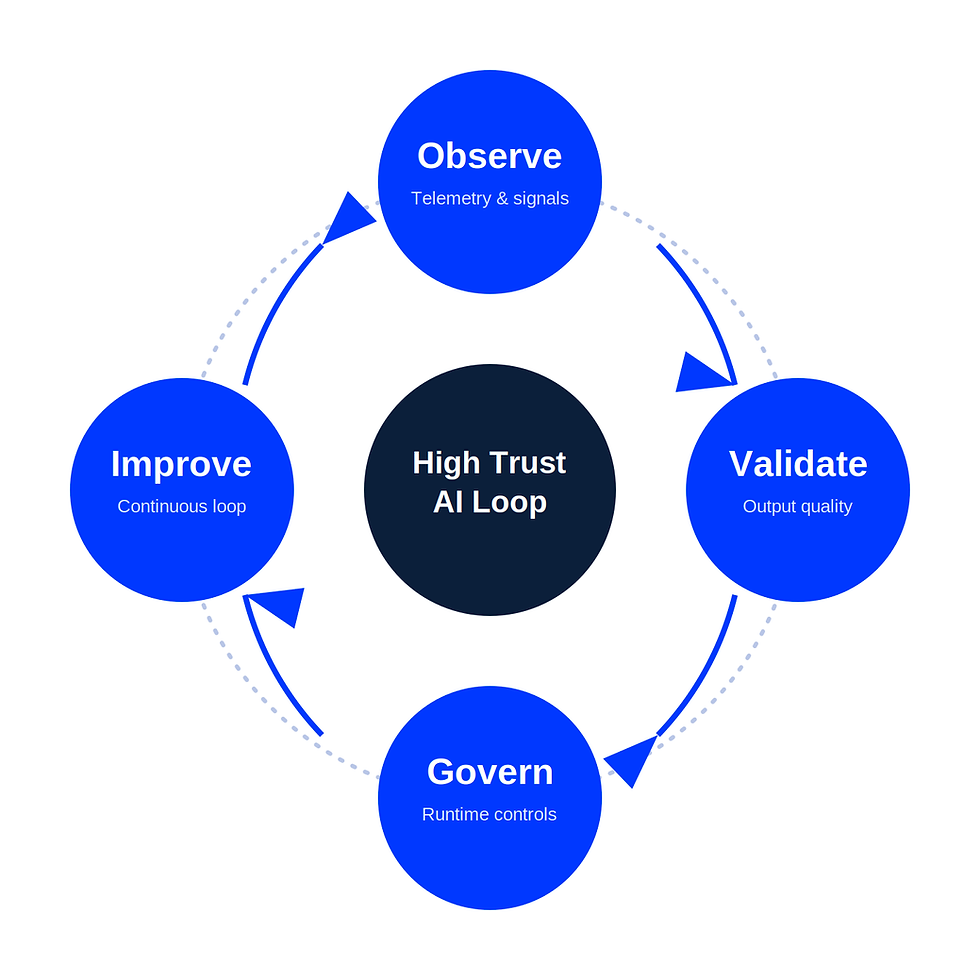
The pillars below describe how to keep a production AI system observable and improving. My new paper covers the layer above them: who may let an agent act, on what evidence, and what is recorded.
Observe
Traditional monitoring — CPU, memory, uptime — is necessary but not sufficient for AI systems. Observability must extend to LLM inference latency, agent reasoning time, tool execution latency, token flow, and agent concurrency — the new 'golden signals' that classic SRE dashboards miss entirely.
Validate
Reliability without quality has zero business value. I track model quality signals directly — relevance, drift, evaluation scores, and hallucination rate — because confident wrong answers are reliability failures even when the infrastructure looks green.
Govern
Governance is now part of runtime observability, not a separate compliance exercise. That means policy adherence checks, prompt injection detection, sensitive data exposure controls, and cost signals (AI FinOps) built into the operating architecture itself — not bolted on after an incident.
Improve
Traditional systems fail silently. AI systems fail confidently. That distinction is why I build continuous evaluation loops rather than one-time launch reviews — organizations that operationalize these signals early build systems that are scalable, trustworthy, and economically sustainable.
Proof Points
Built systems that analyze AI outputs before runtime, cutting customer-reported issues by 90%. (Amazon Quick)
Publish and speak on AI incidents and board-level trust, including a widely-read breakdown of five real-world GenAI governance failures and their board implications.
Led AI governance and model evaluation in regulated BFSI environments at Amazon, establishing explainability frameworks, bias detection, and compliance guardrails that became organizational standards.
Shipped multi-agent and GenAI systems with measurable reductions in human intervention (90%+). (Amazon Receivables Tech)
Shipped multi-agent and GenAI systems with measurable business impact — improving data quality by 50% while cutting inference costs by 30% through smart model routing and caching, not just bigger infrastructure.
The High Trust AI Control Framework
Five controls that decide what an AI agent may do on its own.
Policy enforcement
Rules enforced outside the model: permissions, limits, mandatory approvals and prohibited actions.

Pre-execution validation
Checks identity, current data and system state before anything runs. Outside content is treated as data.
Auditability
A record of the evidence, rules and approvals behind every consequential action.
Exception handling
A third outcome, "cannot determine", sent to a named reviewer instead of a guess.
Human oversight
People own risk, policy and authority, and approve every policy change.
